Learn
Are IQ Tests Accurate? Clinical Tests vs Online Tests
On this page
Are IQ tests accurate? Full clinical IQ tests, given under supervision, are very consistent: a person tends to get a similar score on a retest. Online tests are much less precise. They give a useful estimate, but only as a range, and unsupervised scores run a little high.
Are IQ tests accurate?
IQ tests are accurate in one specific sense: good clinical tests give very consistent scores. The same person, tested again, tends to land close to the first result. That consistency is called reliability.
Accuracy has limits, though. No score is exact, even on the best test. Scores also depend on the test, its norms and the setting. So here is the honest answer. A clinical IQ score is a precise estimate with a small range. An online score is a rough estimate with a wide one.
What does accuracy mean for an IQ test?
Accuracy for an IQ test means two different things: reliability and validity. Reliability asks whether the test gives consistent results. Validity asks whether it measures what it claims to measure.
Reliability is shown as a number from 0 to 1. A reliability of 1 would mean perfectly consistent scores. The Stanford-Binet Fifth Edition reports reliabilities from .95 to .98 for its main IQ scores. That is very high.
Validity is harder to show with one number. It is built up over many studies of what a test’s scores relate to. This page does not make claims about what IQ scores predict in life, because we have not read primary sources on that. We focus on how precise a score is.
What is measurement error?
Measurement error is the natural wobble in any test score. The standard error of measurement (SEM) describes it: how much a person’s score would vary if they took the test many times1. The smaller the SEM, the more we can trust one score.
Clinical reports turn the SEM into a range. In one publisher’s sample report, a full-scale IQ of 111 has an SEM of 3.00 points. Its 95% range is 106 to 1162.
In plain words, the test says the person’s true score very likely lies in that range. The single number in the middle is the best guess, not a certainty. A single IQ with no range leaves this out.
Can a test be reliable but still wrong?
Yes. A test can give the same result every time and still miss what it claims to measure. Reliability only says the scores are consistent.
Picture a bathroom scale that always reads two kilos light. It is perfectly consistent, but every reading is off. A test can behave the same way if its questions measure something else, such as reading speed or trivia knowledge.
This is why good tests publish both kinds of evidence. Consistency is the easy part to check. Whether the questions measure reasoning takes design work and research over many studies.
How accurate are online IQ tests?
Why do online IQ tests run high?
Online IQ tests often run high because of how and by whom they are taken. Two effects work together.
The first is the setting. A review of 49 studies compared unsupervised online ability tests with supervised ones. Unsupervised scores were higher by about 0.2 of a standard deviation, which is about 3 IQ points4. The gap was smaller for tasks that are hard to look up.
The second is who takes the test. People choose to take online tests. Research on web surveys shows that such self-selection can make results unreliable as a picture of everyone5.
Retakes add a third effect. A large review of retest studies found that scores rise when people repeat a test. The gains stopped after the 3rd attempt, and they depended on the test and the time between sittings6. So a best score after several tries is likely to be high.
The next section shows how to judge any test yourself.
How much wider is an online range than a clinical one?
An online range is usually much wider than a clinical one. In one clinical sample report, the 95% range runs from 106 to 116. That is a clinical test with many subtests, given by an examiner.
On our own short test, the 90% range around a result of 100 is about 88 to 112. It is wider even though it claims less confidence, 90% instead of 95%. That is the cost of a short test taken alone at home.
A wide range is not a flaw to hide. It is the true size of the uncertainty, and we would rather show it than print a false exact number.
Is the Mensa online test accurate?
Mensa’s online tests are practice tools, not admission tests. Mensa International describes its online IQ Challenge as entertainment only, and says it will not qualify anyone for membership8.
Mensa Norway’s free online test is similar. It gives only an indication, on a range of 85 to 145, and it says it is not a substitute for a professional test9. For admission, Mensa uses supervised testing. The Mensa IQ test page explains both.
Which IQ test is the most accurate?
What is the most accurate IQ test?
The most accurate IQ tests are full clinical tests given one to one by a trained examiner. Examples are the Wechsler scales and the Stanford-Binet. Their scores come with published reliabilities and ranges.
A full clinical test also measures more than one kind of skill. A modern adult test covers five areas: verbal comprehension, visual spatial skills, fluid reasoning, working memory and processing speed. It takes about 45 minutes for the full-scale score alone3.
Some supervised tests are narrower. Raven’s matrices, for example, is a nonverbal reasoning test. It focuses on one kind of reasoning, not the whole range a full test covers.
If you need a formal result, a supervised test is the only route. Mensa, for example, accepts only approved, supervised tests and never unsupervised internet tests7. The Mensa IQ test page lists the accepted tests. The page on what an IQ test costs explains how to book one.
What is the most accurate free online IQ test?
No free online test can match a supervised clinical test, so “most accurate” online means “most honest about its limits”. Use the checklist above. A test that shows a range, explains its method and charges nothing is doing what an online test can do well.
That is the standard we hold our own test to. We show every result with its range and a percentile, and we publish our method.
How can you tell if a free IQ test is accurate?
You can tell a lot about a free IQ test from what it shows you. Use this checklist:
- It shows the full result for free. A result behind a payment is a warning sign.
- It shows a range, not just one number. Every honest score has error.
- It explains its method. Look for a page on how questions are made and how scores are computed.
- It names its norms. A score means little without the group it is compared with.
- It uses reasoning puzzles, not trivia. Trivia depends on what you have read.
- It makes no “official” or “certified” claims. No online test can certify an IQ.
- It asks for no card and no email to see the result. A common complaint is a small fee to unlock a score, followed by an unexpected monthly charge.
A test that passes all seven is still an estimate. But it is an honest one.
How accurate is our own test?
Our own test is an estimate with a wide range, and we say so on every result. It has 30 questions, which is far fewer than a clinical test. When it shows a score of 100, the 90% range printed next to it is usually about 88 to 112.
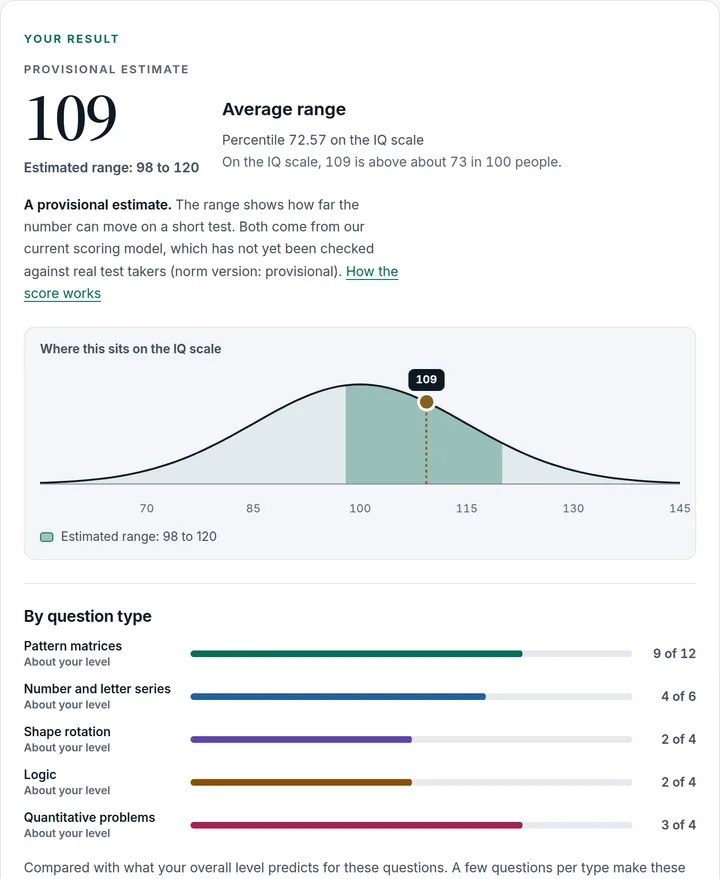
Its norms are provisional. The current norm version is “provisional”. Until enough people have taken the test, its scale comes from a statistical model, not from a norming sample of real people. Our simulations show it measures best in the middle of the scale. At the ends, results are pulled toward the middle, and a perfect answer sheet currently shows about 140.
We also cap what we print. Anything above 145 shows as “145 or higher”, because a short test cannot separate scores that high. Our methodology shows the full numbers, including where the estimate is weakest.
If you want to try it, take the free test. Read your range as seriously as your score.
How should you read any IQ score?
Read any IQ score as a range, from one test, on one day. Check which test and which norms produced it. Check whether it was supervised. And check the label system, because the same score can carry different labels.
The IQ scale explains the labels and bands. The IQ calculator converts scores between tests with different spreads. For what average really means, see the average IQ guide.
FAQ
Are online IQ tests accurate?
Online IQ tests are rough estimates. Unsupervised scores run about 3 points high on average in a large review, and short tests have wide ranges.
Is a clinical IQ test 100% accurate?
No test is 100% accurate. Even a clinical score comes with a range, such as 106 to 116 around a score of 111 in one sample report.
Can your IQ score change?
Your score can change between sittings because of measurement error and practice. Scores usually rise a little on a retest.
Why did I get different scores on different tests?
Different tests use different questions, norms and sometimes different standard deviations. Each score also has its own error. A few points of difference is normal.
What is a reliable IQ test?
A reliable IQ test gives consistent scores when a person is tested again. Clinical tests publish their reliability. Look for that number, and for a range around every score.
Do IQ tests measure intelligence?
IQ tests measure performance on a set of tasks, such as reasoning, vocabulary and memory. The American Psychological Association describes IQ as a standard score from tests of intelligence1. What the score captures depends on the tasks a test uses.
Are practice questions a good way to check accuracy?
Practice questions show you the format, not your score. Our IQ test questions page has worked examples of every type.