Learn
IQ Test Questions and Answers, Explained Step by Step
On this page
- What kind of questions are on an IQ test?
- What are matrix questions?
- What are number and letter series?
- What are mental rotation questions?
- What are logic questions?
- What are math questions on an IQ test?
- Can you study for an IQ test?
- How many questions are on an IQ test?
- How are these questions scored on a real test?
- Are online IQ test questions accurate?
- Try the full test
- FAQ
IQ test questions are short reasoning puzzles: pattern grids, number series, shape rotation, logic and simple math. Below are examples of our own for each kind, from easier to harder. Each one has its answer and a worked explanation, hidden until you open it.
What kind of questions are on an IQ test?
IQ tests ask a mix of tasks. Many are reasoning puzzles that need no special knowledge: find the rule, apply it, pick the answer. Clinical tests add other tasks too, such as vocabulary, memory and speed.
A full clinical test for adults covers five areas. They are verbal comprehension, visual spatial skills, fluid reasoning, working memory and processing speed. It is given by a trained examiner. Its full-scale score needs 7 subtests and takes about 45 minutes.
A short online test like ours cannot copy that. Ours focuses on reasoning puzzles that work on a screen. It uses five kinds, and this page shows all of them. One test has 12 matrix questions and 6 series. It adds 4 rotation, 4 logic and 4 math questions.
What are matrix questions?
Matrix questions show a grid of shapes with one cell missing. You choose the cell that completes the pattern. Each row follows one or more rules. The answer must fit all of them at once.
Rules can change the shape, the number of shapes, the fill or the size. They can also turn a pointer or add marks on the edges. Easy items use one rule. Harder items stack several rules, some of which run across the rows in a less obvious way.
Research on matrix puzzles found that higher scorers mainly differ in two things. They find abstract rules more easily, and they keep track of more rules at once. So take one feature at a time: first shape, then number, then fill, and so on.
Our matrix questions have 6 options. Only one option fits every rule. Our software checks that no other rule could explain a different answer.
Practice question 1 (easier)
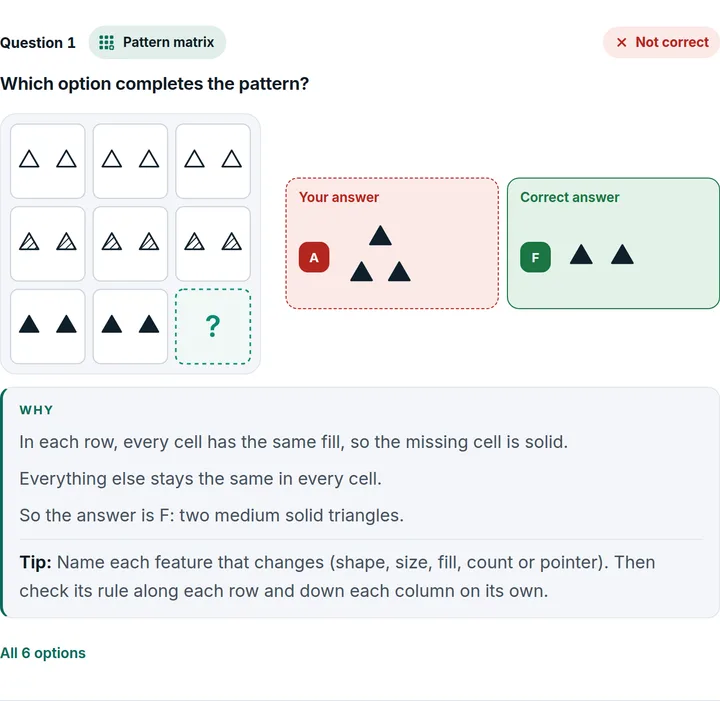
Which option completes the pattern?
Show the answer and explanation
Answer: D.
In each row, every cell has the same fill, so the missing cell is striped.
Everything else stays the same in every cell.
So the answer is D: one medium striped triangle.
Practice question 2 (medium)
Which option completes the pattern?
Show the answer and explanation
Answer: C.
Each row uses the same three shapes, once each. The last row has no pentagon yet, so the missing cell's shape is the pentagon.
Each row uses the same three sizes, once each. The last row has no large shapes yet, so the missing cell's shapes are large.
Everything else stays the same in every cell.
So the answer is C: one large solid pentagon.
Practice question 3 (harder)
Which option completes the pattern?
Show the answer and explanation
Answer: A.
Across each row, the number of shapes goes up by one, so the missing cell has four.
Across each row, the pointer turns 45 degrees clockwise, so the missing cell's pointer is at 45 degrees.
Each row uses the same three fills, once each. The last row has no gray cell yet, so the missing cell is gray.
Everything else stays the same in every cell.
So the answer is A: four medium gray circles, a pointer at 45 degrees.
What are number and letter series?
A series question gives a row of numbers or letters that follow a rule. You find the next one. The rule might add the same amount each time, multiply, or grow the gaps step by step.
Harder series hide the rule better. Two series can take turns in one row. The steps can alternate, such as add, then multiply. Letter series work the same way, using the position of each letter in the alphabet.
A good habit is to write down the gaps between terms. If the gaps are all equal, you have your rule. If they change, look at the gaps between the gaps, or check every second term.
Our series questions have 5 options. Only a few use letters, so the test stays fair to people who read other alphabets.
Practice question 1 (easier)
Which letter comes next?
Series: X, V, T, R, P, N, then a missing term.
Show the answer and explanation
Answer: E.
Each letter is 2 places before the one before it in the alphabet.
So the next letter is 2 places before N, which is L.
The answer is E: L.
Practice question 2 (medium)
Which number comes next?
Series: 243, 81, 27, 9, 3, then a missing term.
Show the answer and explanation
Answer: E.
Each term is the one before divided by 3.
So the next term is 3 divided by 3, which is 1.
The answer is E: 1.
Practice question 3 (harder)
Which number comes next?
Series: 7, 11, 16, 22, 29, 37, then a missing term.
Show the answer and explanation
Answer: B.
The gaps between terms are 4, 5, 6, 7, 8. The gaps grow by 1 each time.
The next gap is 9, so the next term is 46.
The answer is B: 46.
What are mental rotation questions?
Mental rotation questions show a shape and ask which option is the same shape turned around. The catch is that some options are mirror images. A mirror image can never be turned to match; it would have to be flipped over.
Our rotation shapes are built from small squares, like pieces from a block game. Each item has one correct turned copy and several mirror copies. It also has one near copy with a single square moved.
To solve them, pick one feature of the shape, such as a short arm. Track where it goes as you turn. Then check a second feature. If the arm is on the wrong side after turning, you are looking at a mirror image.
Practice question 1 (easier)
Which option is the given shape turned around, without flipping it over?
Show the answer and explanation
Answer: E.
Option E is the given shape after a quarter turn clockwise.
Options A, B and D are mirror images. No amount of turning makes a mirror image match, because it would have to be flipped over.
Option C has one square in a different place, so it is a different shape.
Practice question 2 (medium)
Which option is the given shape turned around, without flipping it over?
Show the answer and explanation
Answer: B.
Option B is the given shape after a quarter turn clockwise.
Options A, D and E are mirror images. No amount of turning makes a mirror image match, because it would have to be flipped over.
Option C has one square in a different place, so it is a different shape.
Practice question 3 (harder)
Which option is the given shape turned around, without flipping it over?
Show the answer and explanation
Answer: C.
Option C is the given shape after a quarter turn clockwise.
Options B, D and E are mirror images. No amount of turning makes a mirror image match, because it would have to be flipped over.
Option A has one square in a different place, so it is a different shape.
What are logic questions?
Logic questions give you a few statements and ask what must follow from them. Ours come in two kinds: group statements and ordering puzzles.
Group statements use made-up words, such as “All wibs are fimps”. The made-up words stop you from using what you know about the world. Only the statements count. You assume each group has at least one member.
Ordering puzzles tell you who is taller than whom. Then they ask who is tallest, shortest or second in line. Sometimes the facts are not enough to decide. Then “It cannot be worked out” is the right answer. Choosing a name would be a guess.
A useful method for group statements is to picture the groups as circles. A conclusion must follow only if no way of drawing the circles breaks it.
Practice question 1 (easier)
Assume each group has at least one member. If both statements are true, which conclusion must also be true?
- All florbs are wibs.
- All florbs are grells.
Show the answer and explanation
Answer: B.
Only the two statements count, even though the words are made up. Each group has at least one member.
All florbs are grells, and all florbs are wibs. The florbs have at least one member, and each one is both. So some grells are wibs.
The other options can be false even when both statements are true, so they do not have to follow.
The answer is B.
Practice question 2 (medium)
Assume each group has at least one member. If both statements are true, which conclusion must also be true?
- Some wibs are fimps.
- No wibs are dralks.
Show the answer and explanation
Answer: A.
Only the two statements count, even though the words are made up. Each group has at least one member.
Some wibs are fimps, and no wibs are dralks. Those wibs are fimps but not dralks, so some fimps are not dralks.
The other options can be false even when both statements are true, so they do not have to follow.
The answer is A.
Practice question 3 (harder)
Assume each group has at least one member. If both statements are true, which conclusion must also be true?
- Some dralks are vemps.
- Some snigs are not dralks.
Show the answer and explanation
Answer: E.
Only the two statements count, even though the words are made up. Each group has at least one member.
For each conclusion listed, the groups can be arranged so that both statements are true and that conclusion is false. So none of them must follow.
The answer is E.
What are math questions on an IQ test?
Math questions on an IQ test use simple numbers to test reasoning, not school math. Typical tasks are rates, ratios, percentages, averages and medians.
Our math questions use whole numbers and plain units such as liters, kilometers and minutes. No money appears, so prices in different countries do not matter. The wrong options come from common slips, such as using the wrong part of a ratio.
Read the question twice before you calculate. Many wrong answers come from answering a slightly different question than the one asked.
Practice question 1 (easier)
A printer prints 8 cards in 4 minutes. At the same rate, how many cards does it print in 7 minutes?
Show the answer and explanation
Answer: E.
It prints 8 / 4 = 2 cards each minute.
In 7 minutes it prints 2 x 7 = 14.
The answer is E: 14 cards.
Practice question 2 (medium)
A tank holds 800 liters when full. It is 25% full. How many more liters are needed to fill it?
Show the answer and explanation
Answer: C.
25% of 800 is 200 liters already in the tank.
800 - 200 = 600 liters are still needed.
The answer is C: 600 liters.
Practice question 3 (harder)
A runner records the kilometers run on five days. What is the median distance in kilometers?
| Day | Distance (km) |
|---|---|
| Day 1 | 23 |
| Day 2 | 27 |
| Day 3 | 26 |
| Day 4 | 24 |
| Day 5 | 19 |
Show the answer and explanation
Answer: C.
Put the values in order: 19, 23, 24, 26, 27.
The median is the middle value: 24.
The answer is C: 24 km.
Can you study for an IQ test?
You can practice for an IQ test, and practice raises scores a little. Those gains come from retaking, so they are not a sign that ability grew. A large review of retest studies found that people score higher when they take a test again. The gains stopped after the 3rd attempt. They also depended on the type of test and the time between sittings.
That matters for how you read a score. A result after lots of practice is likely to be a little high. Your first attempt is the fairest estimate.
Unsupervised online tests have a related problem. A review of many studies found they score slightly higher than supervised tests. The gap was smaller for tasks that are hard to look up. That is one reason we use puzzles rather than trivia.
So what can you usefully do before a test? Read the instructions. Try a few examples like the ones on this page, so the format is familiar. For a supervised test, the page on what an IQ test costs covers how the day works.
How many questions are on an IQ test?
The number of questions on an IQ test depends on the test. Our free test has 30 questions in 25 minutes. A clinical test is built from subtests instead, each with its own set of items.
For example, the Stanford-Binet Fifth Edition has 10 subtests of about 5 minutes each. A clinical adult test reaches its full-scale score with 7 subtests. Mensa Norway’s free online test uses 35 visual puzzles in 25 minutes.
Our methodology explains how precise our own test is.
How are these questions scored on a real test?
On a real test, each answer is marked right or wrong. The result is then turned into a score by comparing it with a norming sample.
Our test works the same way in principle. It estimates your level from your answers and the difficulty of each question. Then it shows an IQ estimate with a 90% range. The IQ scale explains what each score range means. The average IQ page explains where 100 comes from.
Are online IQ test questions accurate?
Online IQ test questions can be well made. Still, a short online test is an estimate, not a clinical result. The page are IQ tests accurate explains the difference in detail.
For a formal result, such as for Mensa, you need a supervised test. The Mensa IQ test page explains the accepted routes. For children, see our guide to IQ tests for kids.
Try the full test
Ready for the real thing? Take the free IQ test. It gives you 30 new questions, generated just for you, and shows an estimate with its range. No email and no payment.
When you finish, every question comes back with the right answer and a worked explanation.
FAQ
What is the hardest type of IQ question?
It depends on the person. On our test, questions go from easier to harder. The hardest ones come at the end.
Are the same questions used every time?
Not on our test. Our generator makes a new set of questions for each attempt, so memorizing answers does not help. The practice questions on this page never appear in the real test.
Can I use paper and a pencil?
On our test, yes. Nothing stops you from making notes. On a supervised test, follow the examiner’s rules.
Do IQ tests have trick questions?
A well-made question has one clear best answer that a rule explains. Our software checks each question for exactly this before it can be used.
Are these questions from a real IQ test?
They come from the same generator as our real test. None comes from a published clinical test. We never copy items from published tests.