Learn
The Mensa IQ Test: What It Is and What Score You Need
On this page
The Mensa IQ test is a supervised admission test. Mensa admits people who score in the top 2% on an approved test. It also accepts qualifying scores from many other supervised tests. No online test, including ours, can get you into Mensa.
What is the Mensa IQ test?
The Mensa IQ test is the admission test that Mensa gives under supervision. You take it in a session run by Mensa volunteers or at an approved testing site. You need photo ID that shows your date of birth.
In the United States, the session takes one to two hours2. It is not offered under age 14. Younger children can apply with qualifying school or clinical scores instead.
Mensa International describes its rule simply. Membership is open to people who score in the upper 2% on an approved, properly supervised intelligence test. Online tests cannot be used for admission9.
What score does Mensa accept?
Mensa accepts a score at or above the 98th percentile on an approved, supervised test. The number that means depends on the test, which is why the lines below differ.
What IQ do you need for Mensa?
You need a score at or above the 98th percentile on an approved, supervised test. That is the top 2%. The exact number depends on the test, because tests use different scales.
Mensa’s supervisory psychologist explains the link to the familiar 130. The 98th percentile is two standard deviations above the mean, rounded off. On a test with a standard deviation of 15, the exact point is 130.8, which rounds to 1303.
This is why a score of 130 on a Wechsler test qualifies. See what a 130 IQ means for how rare it is. About 1 in 44 people score 130 or higher.
Which test scores does Mensa accept?
Mensa accepts qualifying scores from many supervised tests, not just its own. American Mensa publishes the list on its qualifying test scores page. Here are examples from that list:
| Test | Score needed |
|---|---|
| Stanford-Binet 5 | 130 |
| Stanford-Binet (older forms) | 132 |
| Wechsler adult and children scales (FSIQ, full battery) | 130 |
| CogAT (composite SAS) | 132 |
| OLSAT (total SAI) | 132 |
| NNAT2 or NNAT3 | 132 |
| Cattell | 148 |
Wechsler scores count only when the test was given in its entirety. Scores from unsupervised internet tests are not accepted1. Check Mensa’s own page for the current list and for any test not shown here.
Why do the qualifying scores differ between tests?
The qualifying scores differ because tests spread their scores differently. They all set the average at 100, but one standard deviation can be 15, 16 or 24 points. The same top 2% then carries a different number.
Most modern tests use 15, so the line is 130. Older Stanford-Binet forms and many school tests use 16, so the line is 132. The Cattell test uses 24, so the line is 148. All three mark the same rank among people.
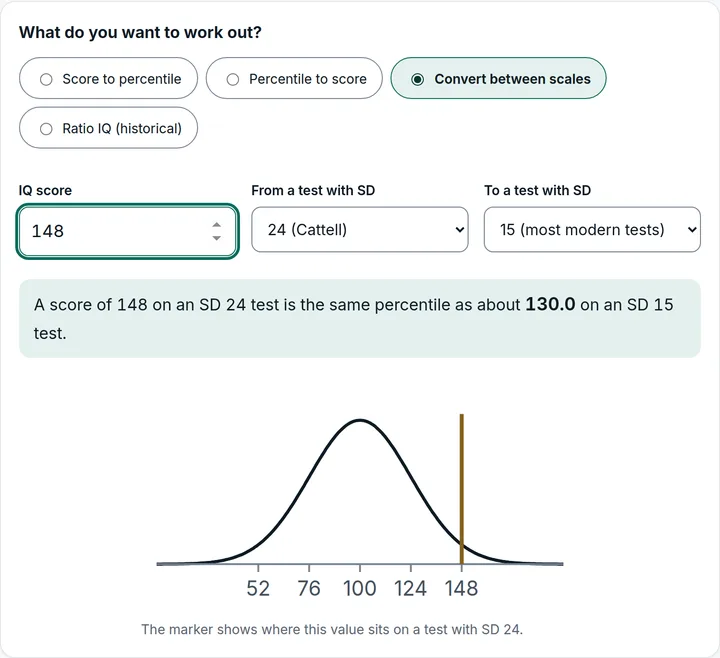
You can convert any score yourself with our IQ calculator. The IQ scale page explains the three scales side by side.
How rare is a Mensa-level score?
A Mensa-level score is reached by about 2 people in 100. That is what the top 2% means: roughly 1 person in 50.
The familiar 130 is slightly more generous than an exact 2%. On an SD 15 test, 130 is at the 97.72nd percentile. So about 2.3% of people score 130 or higher. The exact top 2% starts at 130.8. Mensa’s supervisory psychologist calls it “two standard deviations above the mean (rounded off)”. That is exactly this rounding.
How do you qualify for Mensa?
There are two routes: take Mensa’s own supervised test, or send proof of an accepted score from an earlier test.
How do you take the official Mensa test?
To take the official Mensa test in the United States, book a session on American Mensa’s testing page. There are two options. One is a session run by local group volunteers. The other is a private session at an approved testing site.
The local group session costs $60. The private session costs $99, is taken on a computer, and gives results within days2. Bring photo ID with your date of birth.
You can retake the test once every 8 weeks. Outside the United States, contact your national Mensa, which runs its own testing. Mensa Norway, for example, offers an authorized in-person test for everyone aged 16 and over.
For other formal routes and their cost, see how much an IQ test costs.
Can you use past test scores to join Mensa?
Yes. You can join with a qualifying score from a test you have already taken. It must be on Mensa’s accepted list and supervised. In the US, this is the route for children under age 14, who cannot take the admission test.
School and clinical tests are both on the list. A school ability test such as the CogAT or the OLSAT needs 132 on its composite score. A full Wechsler test needs 130. The next section explains what proof Mensa needs.
What proof of a score does Mensa need?
Mensa needs the original score report or a notarized copy of it1. For a school test, that can be a signed report from the school psychologist on letterhead. An official school transcript or a signed letter from the school office also works.
The name on the document must match the name on your application. If it differs, for example after marriage, you add documents that show the change. American Mensa reviews each application individually and makes the final decision on any test.
Do college admission test scores count for Mensa?
Some do, but only older versions. American Mensa accepts some college and graduate admission tests, such as the ACT, GRE, LSAT and PSAT. They count only if taken before cutoff dates it lists. Newer versions are not accepted1.
If you took one of these tests long ago, check the dates and scores on Mensa’s own page. If your test is too recent, take the Mensa test or a clinical IQ test instead.
Can children join Mensa?
Yes, children can join Mensa with a qualifying score, but in the US they cannot take the admission test under age 14. Younger children apply with a qualifying school or clinical score instead.
Mensa International also warns that many tests are not valid for children under 169. So for a child, look for a test given by a school or a psychologist and normed for the child’s age. Our guide to IQ tests for kids explains those tests.
What is the Mensa online test?
Is the Mensa online IQ test free?
Yes, Mensa’s online tests are free, but they are practice only. None of them can qualify you.
Mensa International’s online IQ Challenge is described as entertainment. It says plainly that it will not qualify anyone for membership, and it suggests a supervised test instead5. Mensa Norway’s free online test gives only an indication of your level6. It reports a range of 85 to 145, from 35 visual puzzles in 25 minutes. It says it is not a substitute for a professional test.
Mensa International also notes that many tests are not valid for children under 16. And a home pre-test is practice, never proof.
How many questions are on the Mensa IQ test?
The number of questions depends on which Mensa test you mean. Mensa Norway’s free online test has 35 puzzles. For the US admission test, we did not find the number of questions on a primary Mensa page. So we do not print one.
What American Mensa does state is the time: one to two hours for the session. Plan for the full session, not just the questions.
How can you prepare, and what if you score just below the line?
How can you prepare for the Mensa test?
You can prepare by getting familiar with the format, not by studying answers. Mensa’s own online practice tests use visual puzzles. Our IQ test questions page has worked examples of the main puzzle types.
Be careful with heavy practice. Retaking tests raises scores a little7, and that gain comes from retaking, not from higher ability. That is fine for a practice score, but the admission test measures you on the day.
What if you score just below the Mensa line?
If you score just below the line, you have not missed by much, and a second try is allowed. Every test score has error. Even a clinical score comes with a range of several points. So a 128 and a 131 can describe the same ability.
You have two options. You can retake the Mensa test after 8 weeks. Or you can take a different accepted test, such as a full clinical test with a psychologist. Keep in mind that retakes usually score a little higher than first attempts.
What can an online score tell you about Mensa?
Is our test a Mensa test?
No. Our test is not a Mensa test, is not approved by Mensa, and cannot be used to join Mensa. No unsupervised online test can.
What our test can do is give you a free estimate of where you might stand. It has 30 questions and shows a 90% range and a percentile. If the result is near the top, a supervised test is the next step. Take the free test to see your estimate.
Keep in mind that unsupervised online tests score a little high. A large review found a gap of about 3 points8. The page are IQ tests accurate explains why.
Does a Mensa score make you a genius?
No. Mensa’s line is a score, the top 2%, not a judgment of genius. Mensa’s own supervisory psychologist notes that psychological dictionaries define no “genius” IQ3. Our page on what IQ is considered genius explains where the popular 140 line came from.
FAQ
What IQ do you need to get into Mensa?
You need a score in the top 2% on an approved, supervised test. On Wechsler tests that is 130. On older Stanford-Binet forms it is 132, and on the Cattell test 148.
How much does the Mensa test cost?
In the United States, American Mensa lists $60 for a local group session and $99 for a private session.
Can I take the Mensa test online?
You can take Mensa’s online practice tests, but they cannot qualify you. American Mensa’s private sessions use a computer, but they are held at approved testing sites, not at home.
How old do you have to be to take the Mensa test?
In the United States, the admission test is not offered under age 14. Younger children can apply with qualifying school or clinical scores.
How often can you take the Mensa test?
American Mensa allows one attempt every 8 weeks.
What is the Mensa IQ Challenge?
The Mensa IQ Challenge is Mensa International’s free online practice test. Mensa describes it as entertainment only. It cannot qualify you, and Mensa suggests a supervised test instead.
Is 130 enough for Mensa?
Yes, on the Wechsler scales and the Stanford-Binet 5, a supervised 130 qualifies. On tests with a wider spread, the line is higher, such as 148 on the Cattell test.
Does a high online score mean I will pass the Mensa test?
No. An online score is an estimate with a range, and unsupervised scores run a little high. It can suggest whether a supervised test is worth trying, but it cannot predict the result.
What test does Mensa use?
Mensa uses its own supervised admission test, and it also accepts many other supervised tests. The list includes the Wechsler scales, the Stanford-Binet, the CogAT, the OLSAT and the Cattell.